

Replacing Wire Ropes on the Spijkenisserbrug Bridge: The Mennens Approach
At the Spijkenisserbrug Bridge, we are replacing critical wire ropes that are essential for the bridge's reliable operation. This exceptional project involves several weeks of work, a large team of specialists on-site and one essential requirement: shipping traffic must be able to continue without interruption.
Executive Summary
The Spijkenisserbrug is a large and complex movable bridge where wire ropes play a critical role in its operation.
Based on annual inspections, the decision was made to replace wire ropes that no longer met the required safety standards.
Each bridge section has 32 counterweight cables (Ø 64 mm, 50 metres long) that enable the movement of the bridge deck and counterweight.
The wire ropes have been pre-stretched, fitted with cast sockets and marked with an orange paint stripe to prevent incorrect installation caused by twisting.
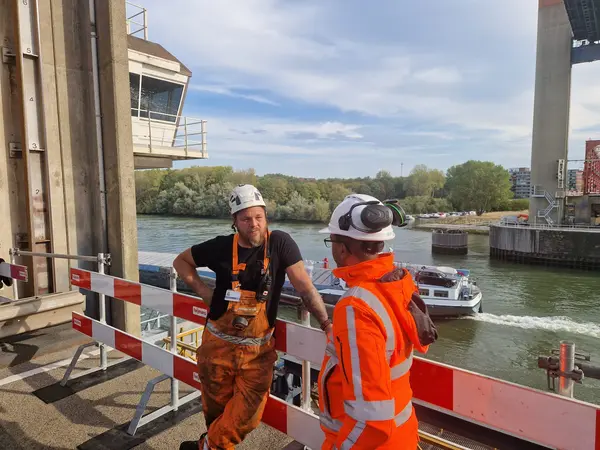
A team of 18 skilled specialists from several Mennens branches is working on the bridge.
Testing and quality assurance are carried out in accordance with NEN 3560 and Rijkswaterstaat's requirements as specified in the ROK (Guidelines for the Design of Civil Engineering Structures).
Project at a Glance
This is what a typical bridge maintenance project involves in practice:
Annual inspections to assess the condition of the wire ropes and determine when replacement is necessary.
Advance preparation to coordinate planning, accessibility and safety.
Manufacturing and pre-stretching of the wire ropes, including end terminations and sockets.
On-site installation according to a carefully planned schedule, using weekend work windows to minimise disruption.
Testing and handover in accordance with applicable standards and customer requirements.
Why the Spijkenisserbrug Is Such a Unique Project
The Spijkenisserbrug is one of the larger bridges in the Netherlands, and a project of this scale requires extensive preparation and coordination.
Several challenges need to be considered:
Multiple disciplines working simultaneously, including installation, logistics, safety and coordination with surrounding stakeholders.
A busy road connection in the immediate vicinity.
One essential requirement: shipping traffic must be able to continue without interruption.
As a result, a project like this needs to be planned well in advance. During the tendering process, the most suitable contractor is selected based on the project's requirements. For this particular project, Mennens was chosen to carry out the work.
From Annual Inspections to Wire Rope Replacement
To ensure the continued safe operation of a movable bridge, asset managers need reliable information about the condition of its wire ropes.
That is why we carry out annual inspections to identify wear, broken wires, corrosion and other signs of deterioration at an early stage.
Based on the inspection results at the Spijkenisserbrug, the decision was made to replace the affected wire ropes because they no longer met the required standards.
This approach helps prevent unexpected failures and allows replacement work to be planned and carried out in a controlled manner.
“Price is never our primary consideration. What matters most is the ability to carry out the work and the quality of the work delivered.”
— Rijkswaterstaat
Technical Scope: Counterweight Cables, Hoisting Cables and Hauling Cables
This project focuses on wire ropes that play a critical role in the movement and operation of the bridge.
Counterweight Cables: 32 per Bridge Section
Each bridge section is equipped with 32 counterweight cables, each with a diameter of 64 mm and a length of 50 metres. These cables enable the controlled movement of the bridge deck and counterweight, allowing the bridge to open and close safely.
Bridge Corners: Hoisting and Hauling Cables
At each of the four corners of the bridge, the system includes:
4 hoisting cables
4 hauling cables
The installation is carried out in phases. During one scheduled work window, we install the hoisting cables, followed by the hauling cables in the next work window. This phased approach ensures control over safety, planning and testing.
asset_image
Preparation and Accessibility: Managing Traffic Without Disrupting Operations
For a bridge of this size, simply closing it off is not an option. The bridge connects Spijkenisse and Hoogvliet and is surrounded by busy traffic routes. That is why we arrange several essential aspects well in advance:
Traffic management and diversion routes: Temporarily closing roads where necessary.
Stakeholder coordination: Aligning activities with all parties involved.
Logistics: Organising deliveries, equipment removal, lifting operations, work areas and designated safety zones.
Continuity of shipping traffic: Ensuring that vessels can continue to pass through at all times.
In practice, this means the bridge may be temporarily closed to road traffic during maintenance work, while remaining operational for shipping traffic.
Production and Quality Assurance: Pre-Stretching, Sockets and Reliable Installation
A significant part of the project involves preparation long before our team starts working on the bridge itself.
For the Spijkenisserbrug, we spent two to three months working full-time on the following activities:
Pre-stretching the wire ropes.
Manufacturing and assembling the cable sets.
Casting sockets onto the wire ropes to create secure end terminations.
Winding the cables onto reels to ensure controlled installation inside the bridge towers and connection to the counterweights.
asset_image
On-Site Installation: 18 Specialists, One Team
Successful execution on-site depends heavily on teamwork. During this project, a team of 18 specialists from various Mennens branches is working together on the bridge.
This collaborative approach provides several advantages:
Direct communication and efficient coordination during installation.
Clear responsibilities and task allocation.
A strong focus on safe working practices, even under time pressure.
Equally important is the expertise of the people involved. Without skilled professionals, a project of this scale simply would not be possible. Safety, craftsmanship and the right equipment are essential for a successful wire rope replacement.
Testing in Accordance with NEN 3560 and Rijkswaterstaat Requirements (ROK)
Civil engineering structures such as bridges and locks are subject to strict requirements regarding design, installation and verification.
As part of this project, we carry out the necessary tests in accordance with NEN 3560 and the requirements established by Rijkswaterstaat in the ROK (Guidelines for the Design of Civil Engineering Structures).
These tests are essential for demonstrating that the installation operates safely and reliably, both now and in the years to come.
What Does This Mean for You as an Asset Manager or Contractor?
If you are responsible for equipment availability, safety and maintainability, these are the key benefits you can expect:
Predictability: Wire ropes are replaced based on inspection data rather than unexpected failures.
Minimal disruption: Work phases and traffic diversions are carefully planned in advance.
Reliable installation: Wire ropes are fully prepared through pre-stretching, socketing and clear identification markings.
Demonstrable quality: Testing is carried out in accordance with applicable standards and customer requirements.
Need Expert Advice on Wire Rope Inspections, Replacement or Maintenance Planning?
Are you looking for expert advice on wire rope inspections, replacement or a structured maintenance approach for a movable bridge or lock?
Contact us to discuss your project. Together, we will assess the scope, planning, safety requirements and quality assurance needed to ensure a reliable and successful result.


