

Hazardous Conditions
When using wire rope slings under hazardous conditions, the risks must be assessed by a competent person. Examples of hazardous conditions include offshore lifting operations, lifting personnel, and lifting potentially hazardous loads such as molten metals, corrosive materials, or radioactive substances. In these situations, it may be necessary to reduce the Working Load Limit (WLL) of the wire rope sling to ensure safe operation.
Wire Rope Slings
General
Wire rope slings are generally easier to handle and more cost-effective than chain slings. Galvanised wire ropes provide excellent protection against corrosion, while stainless steel wire ropes are a better choice for highly corrosive environments. For extremely heavy lifting applications, wire rope slings are often the preferred solution.
Standard
Wire rope slings must comply with the European Standard EN 13414-1+A2.
Material and Design
The wire rope used to manufacture wire rope slings must have a tensile strength of 1770 N/mm² or 1960 N/mm².
For multi-leg slings, each leg must have the same rope diameter, rope construction, tensile strength, and grade of the end fittings used.
When a master link is used, its Working Load Limit (WLL) must be at least equal to the WLL of the complete sling assembly.
For three-leg and four-leg slings, a master link with intermediate links must be used. The Working Load Limit of each intermediate link must be at least 1.6 times the WLL of the individual sling leg connected to it.
Ferrules and Spliced Eyes
There are several methods for connecting a wire rope to a master link or end fitting, or for producing an endless wire rope sling.
The most common method is to mechanically secure a thimble or wire rope eye using an aluminium ferrule, also known as a Talurit ferrule. Another commonly used method is to create an eye by means of a hand splice. Specific requirements apply to each of these termination methods.
Minimum Length
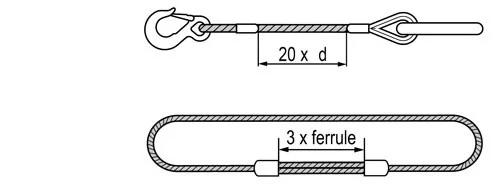
The minimum length of wire rope between two ferrules must be at least 20 times the nominal rope diameter.
For hand-spliced slings, the minimum length of wire rope between the splices must be at least 15 times the nominal rope diameter.
For endless mechanically ferruled wire rope slings, the distance between the ferrules must be no less than three times the length of the ferrule after pressing.
Eye Dimensions
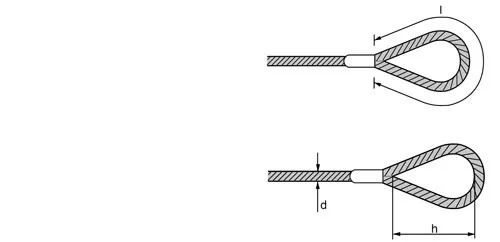
The circumference (l) of a wire rope eye must be at least four times the rope diameter.
As a standard, Mennens specifies that the eye length (h) should be at least 15 times the rope diameter (d).
Sling Length
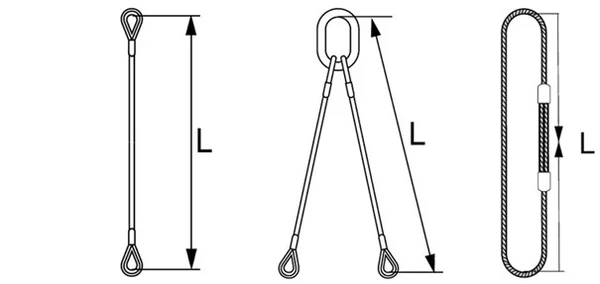
The length (L) is measured between the bearing points of the sling or, in the case of an endless sling, as the overall circumference.
Single-Leg and Endless Slings
The measured length of a mechanically ferruled sling must not deviate from the nominal length by more than two rope diameters or 1% of the nominal length, whichever is greater.
The measured length of a hand-spliced sling must not deviate from the nominal length by more than four rope diameters or 2% of the nominal length, whichever is greater.
When a single-leg sling is intended for use as part of a matched sling set, the length difference between mechanically ferruled eye slings must not exceed one rope diameter or 0.5% of the nominal length, whichever is greater.
Multi-Leg Slings
The measured length of each individual leg of a mechanically ferruled multi-leg sling must not deviate from the nominal sling length by more than two rope diameters or 1% of the nominal length, whichever is greater.
In the unloaded condition, the difference in length between the individual legs of a multi-leg sling must not exceed 1.5 times the rope diameter or 0.5% of the nominal length, whichever is greater.
Wire Rope Grommets (Endless Cable-Laid Slings)
For wire rope grommets with a diameter of less than 61 mm, the permissible tolerance is ±1 rope diameter (d) or ±1% of the nominal length, whichever is greater.
For wire rope grommets with a diameter of greater than 65 mm, the permissible tolerance is ±0.5 rope diameter (d) or ±0.5% of the nominal length, whichever is greater.
Marking
Every wire rope sling must be fitted with an identification tag or be permanently marked on the master link or ferrule (for example, wire rope legs and endless slings).
The marking must include:
Manufacturer identification
Working Load Limit (WLL)
Sling length
Date of manufacture
CE marking
For multi-leg slings, the applicable Working Load Limits (WLLs) for the relevant included angles must also be indicated.
Working Load Limit (WLL) for Wire Rope Slings
Single-Leg Sling
WLL (tonnes) = (Fmin × KT) / (Zp × g)
Endless Sling
WLL (tonnes) = (Fmin × KT × 2 × 0.8) / (Zp × g)
Multi-Leg Sling
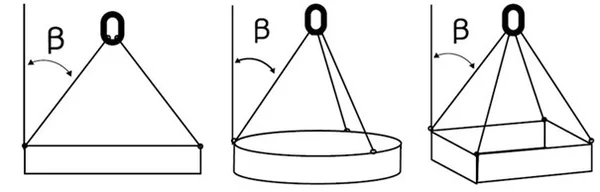
WLL (tonnes) = (Fmin × KT × KL) / (Zp × g)
Where:
Fmin = Minimum breaking force of the wire rope (kN)
KT = Reduction factor for the type of end termination:
0.9 for a mechanically ferruled termination
0.8 for a hand-spliced termination
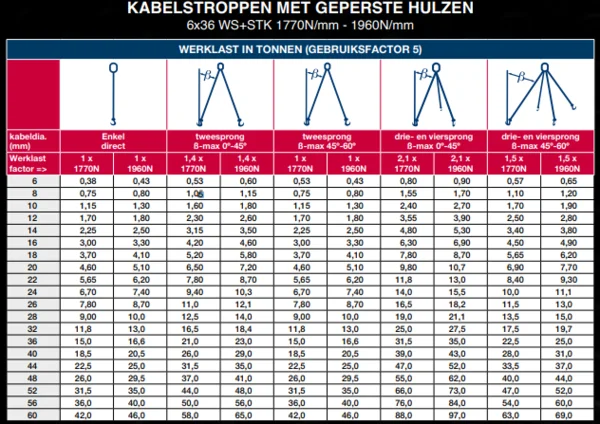
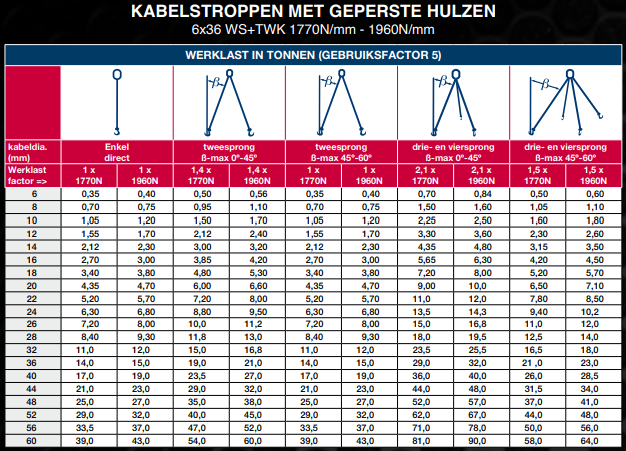
KL = Leg factor, based on the number of sling legs and the included angle relative to the vertical (see the WLL table)
Zp = Utilisation factor (safety factor), equal to 5
g = Conversion factor from force to mass, equal to 9.80665
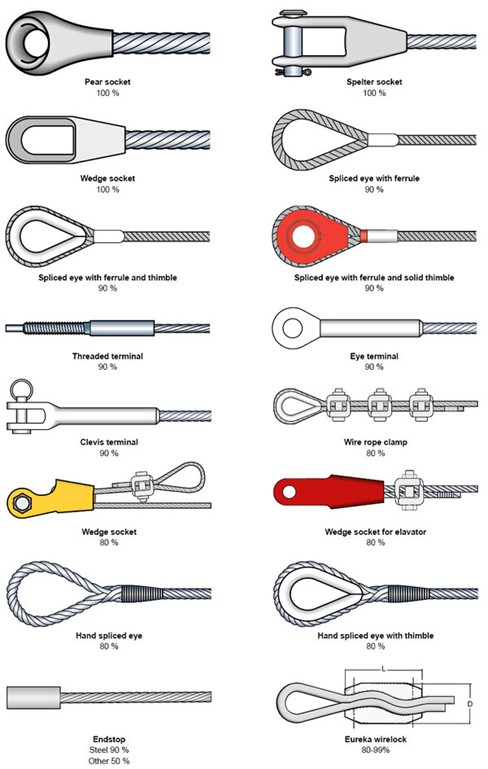
End Terminations and Working Load Reduction Factor (KT)
The table below shows the most commonly used end terminations together with the remaining percentage of the wire rope's minimum breaking force.
For example, if an end termination retains 90% of the minimum breaking force, the corresponding reduction factor (KT) is 0.9.
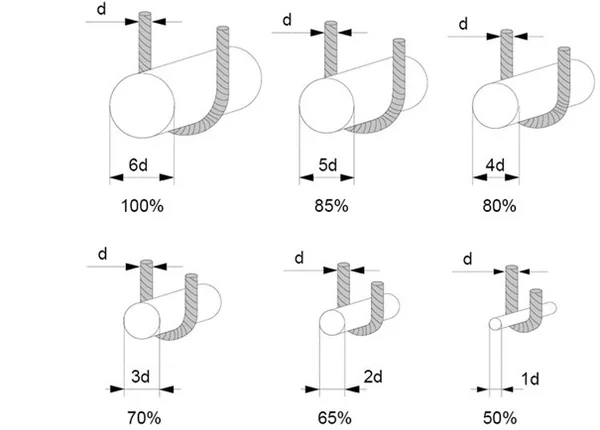
Effect of Bending Diameter on the Working Load Limit (WLL)
Keep in mind that the Working Load Limit (WLL) of a wire rope sling decreases as the bending diameter becomes smaller.
For example, if the wire rope bends around a support point with the same diameter as the rope itself, its lifting capacity is reduced by approximately 50%. See the illustration below.
More information
Would you like more information about the safe and proper use of wire ropes? Contact your nearest Mennens location for expert advice.


