

Cables for the Acoustic Reflectors at TivoliVredenburg
In July, Mennens carried out an unusual wire rope project at TivoliVredenburg, the music and cultural centre in Utrecht. Following an extensive renovation in June 2014, Tivoli Oudegracht and Vredenburg Music Centre, previously two separate venues, joined forces under the name TivoliVredenburg.
The renovated music centre features five unique concert halls, each with its own character and purpose. One particularly striking venue is the so-called 'Grote Zaal' (Main Hall). This hall was already part of the original Vredenburg Music Centre. During the renovation, it was incorporated into the new building, which now forms the modern façade at the intersection of Vredenburg and Catharijnesingel.
The Challenge
Some time ago, Mennens was asked to provide expert advice on the wire ropes supporting the acoustic reflectors suspended in the Main Hall. Following an inspection of these wire ropes, Mennens recommended replacing them.
The logical next question was whether the wire ropes could be replaced during the next scheduled major maintenance period.
An interesting detail is that the original wire ropes were supplied in February 1989 by Den Haan Handel B.V. in Gorinchem, the company now known as Mennens Dongen.
What Are Acoustic Reflectors?
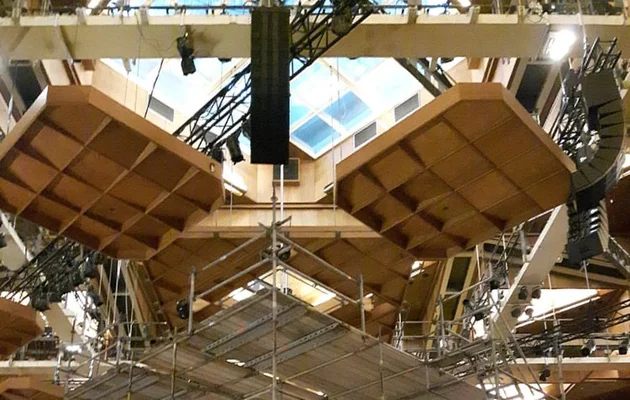
Acoustic reflectors are wooden panels suspended in a concert hall to improve its acoustics. The Main Hall features six smaller, fixed acoustic reflectors and one large central reflector that can be adjusted vertically.
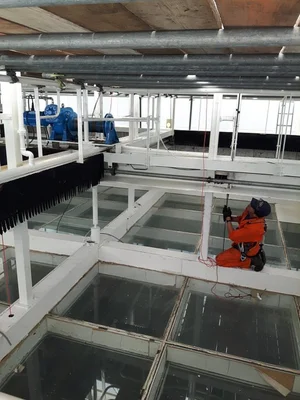
The smaller reflectors are attached to the hall's structure using three-leg wire rope assemblies. The large central reflector is suspended by four individual wire ropes connected to a winch system located more than 16 metres above the reflector. This system is positioned above a glass ceiling, inside the building's dome.
The winch system allows the height of the central reflector to be adjusted, which is sometimes necessary to achieve the desired acoustics. For example, a pop concert requires a different reflector height than a classical music performance.
Initially, only the wire ropes supporting the large central reflector were replaced. The cables supporting the smaller reflectors will be replaced at a later stage.
The Wire Ropes
To ensure that the acoustic reflector can be positioned perfectly level, each wire rope was divided into two sections and connected using a turnbuckle. This design allows for precise adjustments to the suspension system.
For the suspension, 8 mm Veropro8 wire ropes were used. Each complete wire rope assembly has a total length of 22.5 metres.
The acoustic reflectors viewed from below, with the smaller reflectors on the left and right and the large central reflector in the middle.
Installation
Several important preparations were required before the installation work could begin. The main challenges of this wire rope replacement project involved three key factors:
Limited time: The work had to be completed within a tight schedule.
Working at height: Accessing the central acoustic reflector required working at a height of approximately 25 metres.
Supporting the reflector: The acoustic reflector had to be supported so that all four wire ropes could be released from tension simultaneously, as they were all connected to a single winch drum.
Due to the wooden floor and differences in floor levels, using a mobile elevating work platform was not an option. Supporting the acoustic reflector was therefore a crucial consideration.
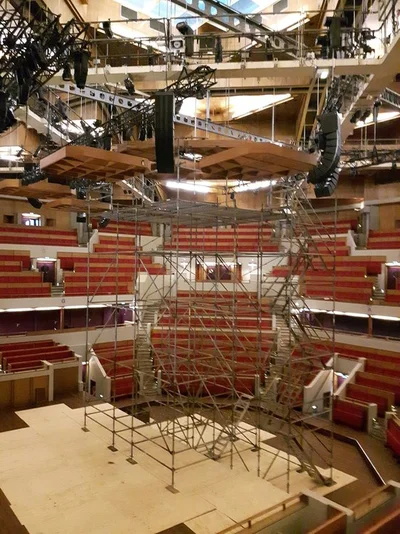
Eventually, a solution was developed involving the construction of a scaffolding structure inside the concert hall. This structure was erected on behalf of TivoliVredenburg before the work began.
The scaffolding platform provided a stable surface on which the large acoustic reflector could rest, allowing all four wire ropes to be safely removed without tension. It also gave the Mennens technicians safe and convenient access to carry out their work.
The completed scaffolding formed an enormous structure in the centre of the concert hall. Once everything was ready on Wednesday, the technicians could begin the replacement work.
First, the existing wire ropes were dismantled and removed. On the second day, the installation of the new wire ropes began. This presented another challenge, as a glass ceiling separated the winch system from the acoustic reflector, meaning the cables had to be carefully guided through it.
Because the turnbuckles needed to remain accessible for future fine adjustments, it was essential to position them at the correct height above the glass ceiling.
On the third day, the final wire ropes were installed and the acoustic reflector was carefully adjusted until it was perfectly level.
The team completed the project just in time, before the scaffolding was scheduled to be dismantled on Saturday.
Thanks to this successful installation, the acoustic reflector can once again hang safely above the Main Hall for years to come, providing the right acoustics for many future concerts.
Mennens would like to thank TivoliVredenburg for its trust and looks back on an enjoyable project in a truly unique setting.


