

From the Archives: The Eastern Scheldt Storm Surge Barrier
Source and author: Henk de Goey, former Mennens employee
In the early 1980s, construction began on the Eastern Scheldt Storm Surge Barrier. It would become an enormous engineering project, costing several billion Dutch guilders. As a wire rope manufacturer and supplier, Den Haan Wire Rope Factory (now Mennens Dongen) made a significant contribution to the marine construction activities involved in this ambitious project.
The first order we received from the Dosbouw consortium was for the supply of fender cables. A tidal channel had formed between the artificial island of Neeltje Jans and the mainland, across which a temporary construction bridge was built. This allowed all construction traffic to reach the island. There were three tidal channels, known as Roompot, Schaar and Hammen, where the barrier's pillars would eventually be installed.
Construction Vessels
Various specialised construction vessels were required to carry out the work in the Eastern Scheldt. Those familiar with the project may remember names such as Mytilus, Macoma, Cardium, Ostrea and Johan V. I'll come back to the latter shortly.
These vessels were built in the Netherlands at considerable expense. However, once the Eastern Scheldt project was completed, they were no longer used.
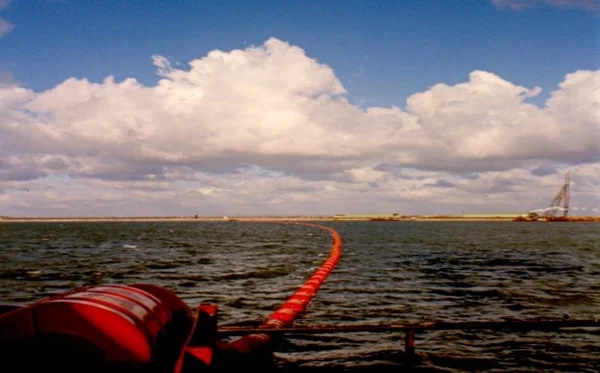
At one point, the project team began considering what might happen if these vessels broke free from their working anchors during severe weather conditions. This led to the development of a safety solution: installing a steel wire rope barrier across the tidal channels, floating at the waterline.
To achieve this, floats had to be attached to the wire rope at two-metre intervals. These floats were installed on board the Johan V.
But this raised an important question: how could a wire rope floating in the water stop a large construction vessel that had broken free from its anchors?
The solution was to equip the construction vessels with special hooks designed to catch onto the fender cable if a vessel broke loose.
The wire rope itself had a diameter of 98 mm, with a considerable length and weight. In addition, sockets had to be fitted to both ends of the cable.
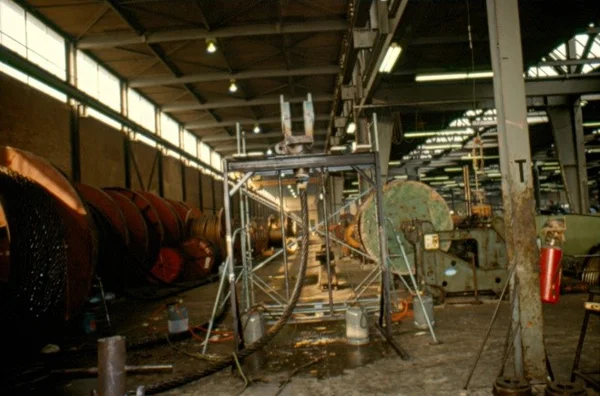
The machine used to manufacture this cable was located at the site where the heavy-duty wire rope unreeling stand is now positioned for producing SuperSlice assemblies.
This was also the heaviest and thickest wire rope ever manufactured by Den Haan Wire Rope Factory.
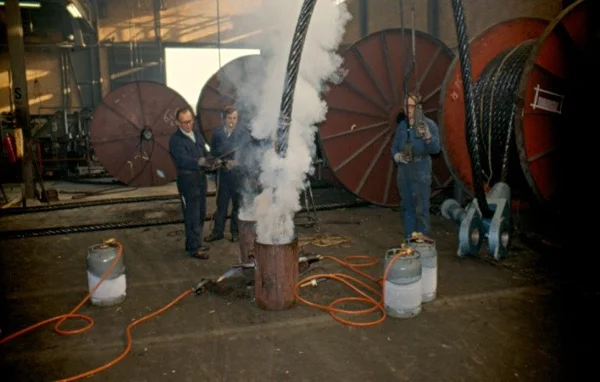
The socket fitted to the first fender cable in Dongen was secured using a lead-antimony alloy, which was the standard method used at the time (see photo).
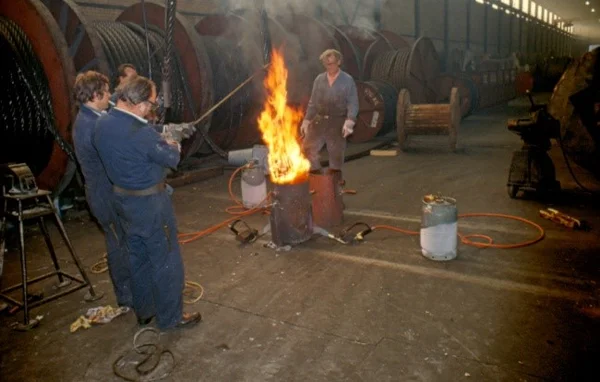
This was a labour-intensive process, as everything had to be heated to a specific temperature using gas burners. At our facility in Gorinchem, we had special furnaces equipped with thermostats that kept both the casting alloy and the tin at the correct temperature at all times.
Socketing Wire Ropes
At the time we were preparing these wire ropes in Dongen, Rijkswaterstaat (the Dutch Directorate-General for Public Works and Water Management) had not yet approved the use of WireLock for socketing applications. Back then, WireLock was not commonly used as a socketing compound. Rijkswaterstaat believed there was insufficient practical experience with the product to justify using it on such a critical project.
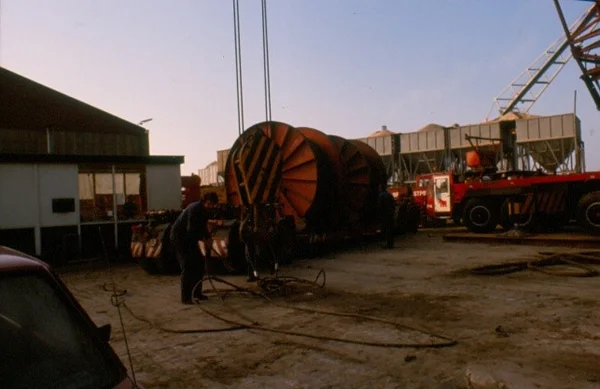
Once we had cast the three sockets onto the wire ropes positioned on top of the reels, they had to be transported to Zeeland, where they would be installed on board the Johan V.
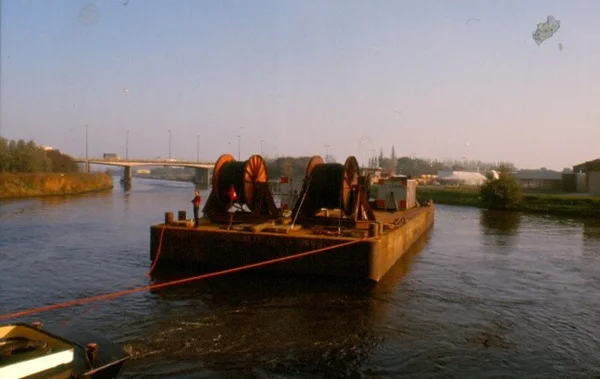
On board the construction vessel, once the floats had been attached to the wire rope and the required length had been determined, we had to cast the second socket onto the cable. Carrying out this socketing process on-site was quite a complicated task at the time, especially with a wire rope of this diameter. The tools shown in the photographs below represent only a fraction of the equipment required.
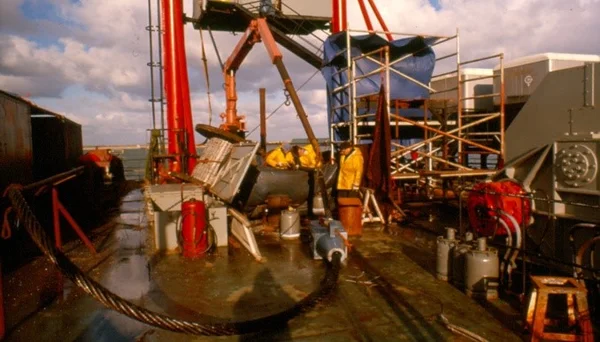
Once the cable deployment, installation of the floats and socketing work had been completed, a process that took two weeks in total, the tools and equipment could be returned to Gorinchem.
Getting the Cable Length Right Is Essential
The installation of the cables across the tidal channels was carried out by Dosbouw. However, it turned out that the contractor consortium had miscalculated the required length: the first cable had been measured two metres too long.
This presented quite a challenge, especially as everything had to be resolved at very short notice. We were asked to shorten the cable and recast the socket. However, this was not something we could arrange quickly, as it meant bringing all the necessary equipment back on board, as described earlier.
We proposed using WireLock for the socketing process instead. This would make the job considerably easier for us and also provide an opportunity to demonstrate WireLock to Rijkswaterstaat.
Rijkswaterstaat approved the proposal, provided we could complete the work within a very short timeframe.
The very next day, we arrived with degreasing agents, a bench vice, hand tools and 12 litres of WireLock, which was the amount required to fill the socket. This was the first time we had attempted to use such a large quantity of WireLock in a single socket.
At our workshop in Gorinchem, we had previously socketed wire ropes with diameters of up to approximately 60 mm, but this was an entirely different challenge.
We cut the cable to the correct length, slid the socket onto the wire rope, opened up the wire strands to form a brush, degreased everything and positioned the socket correctly.
Using a crane, we lifted the socket and cable to a suitable working height. We then carefully sealed the bottom of the socket, or so we thought.
Ready for Casting
It was a beautiful sunny day, with temperatures reaching 30°C. We mixed the powder and liquid components in a large bucket and poured the mixture into the socket.
We checked underneath the socket for any signs of leakage. At first, everything looked fine.
But shortly afterwards, some of the compound began seeping through the sealing putty. No matter what we tried, we couldn't stop it. Approximately 12 litres of WireLock leaked out.
It turned out that this was simply too much WireLock to pour in one go. But how were we supposed to know that at the time?
We called to request another supply of WireLock. My manager at the time wondered how we could get it to Burgh-Haamstede quickly enough.
Fortunately, we soon came up with a solution. He would drive from Gorinchem to Alblasserdam, while I would drive from Burgh-Haamstede to meet him there.
He thought this was a fair way to split the driving distance, although his understanding of the distances involved was somewhat questionable!
Still, we were just relieved that we would be able to finish the job that same day.
The second casting attempt went smoothly. After all, enough WireLock from the first attempt had remained at the bottom of the socket to create a proper seal.
All's Well That Ends Well
The experience ultimately gave Rijkswaterstaat sufficient confidence in WireLock. From that moment onwards, we were allowed to use WireLock without restrictions for a wide range of applications throughout the entire Eastern Scheldt project.
Over the years, we carried out numerous socketing operations on anchor cables and other wire rope assemblies aboard the various construction vessels involved in the Eastern Scheldt project.
Throughout all those years of working with WireLock, we never experienced any further problems.
In the end, everything worked out extremely well.
And that was my very first experience of using such a large quantity of WireLock for a single socketing operation.


